
I was listening to the marvellous writer Alan Bennett on the radio recently, talking about his work, and it inspired me to rethink how I should introduce the importance of observational skills in experimental science (and indeed in any form of data analysis). Bennett wrote a series of monologues called Talking Heads, which were famously broadcast on the BBC in the late '80s, involving several of Britain's finest actors. These short monologues were a vehicle for Bennett to express his observations on human behaviour mainly in the face of perceived adversity: dealing with death or loneliness for example. [You will probably be more familiar with his theatrical and film successes such as "The History Boys" or "The Madness of King George"].
 So
let me move onto "observation" now, before I return to my opening
introduction to Alan Bennett. Experimental Science originally relied
completely on observations made via the human senses. The fascination
shown by the ancients for the moon, the stars and our solar system, is
one example. The curiosity shown by the early scientists such as
Aristotle to investigate the inside of a fruit, a seed, a rat, a snail
etc, using dissection, accompanied by some form of annotated
illustration, is another example. As mankind began to explore the world
around him/her, by perturbing things; the ability to make observations,
note them down and communicate them, formed the basis of scientific
knowledge. [I am not proposing to discuss note taking and communication
in this post, but they are equally important.]
So
let me move onto "observation" now, before I return to my opening
introduction to Alan Bennett. Experimental Science originally relied
completely on observations made via the human senses. The fascination
shown by the ancients for the moon, the stars and our solar system, is
one example. The curiosity shown by the early scientists such as
Aristotle to investigate the inside of a fruit, a seed, a rat, a snail
etc, using dissection, accompanied by some form of annotated
illustration, is another example. As mankind began to explore the world
around him/her, by perturbing things; the ability to make observations,
note them down and communicate them, formed the basis of scientific
knowledge. [I am not proposing to discuss note taking and communication
in this post, but they are equally important.] The picture on the right, is a bacterial culture (in fact a strain of Escherichia coli), plated
on nutrient agar. I remember asking a group of Y12 students to give me
their observations. After a slow start, I suggested that they should try
explaining it as if they were on the radio. Undoubtedly, my favourite
description was "a pale brown jelly, covered by very small drops of
candle wax". I like this description, because to me it uses very strong
images, "set jelly" and "molten candle wax": things that most people
will have seen. It is in my view a memorable description. This is also
the skill of a great writer. When Bennett describes an experience, a
feeling or somebody's expression, for me it is often memorable and
thought provoking. This is what a good observation should be. Why is the agar like a jelly? and just what is
the material that looks like molten wax? And.....why does it smell the
way it does, unpleasant like a waste bin on a summer's day?
The picture on the right, is a bacterial culture (in fact a strain of Escherichia coli), plated
on nutrient agar. I remember asking a group of Y12 students to give me
their observations. After a slow start, I suggested that they should try
explaining it as if they were on the radio. Undoubtedly, my favourite
description was "a pale brown jelly, covered by very small drops of
candle wax". I like this description, because to me it uses very strong
images, "set jelly" and "molten candle wax": things that most people
will have seen. It is in my view a memorable description. This is also
the skill of a great writer. When Bennett describes an experience, a
feeling or somebody's expression, for me it is often memorable and
thought provoking. This is what a good observation should be. Why is the agar like a jelly? and just what is
the material that looks like molten wax? And.....why does it smell the
way it does, unpleasant like a waste bin on a summer's day?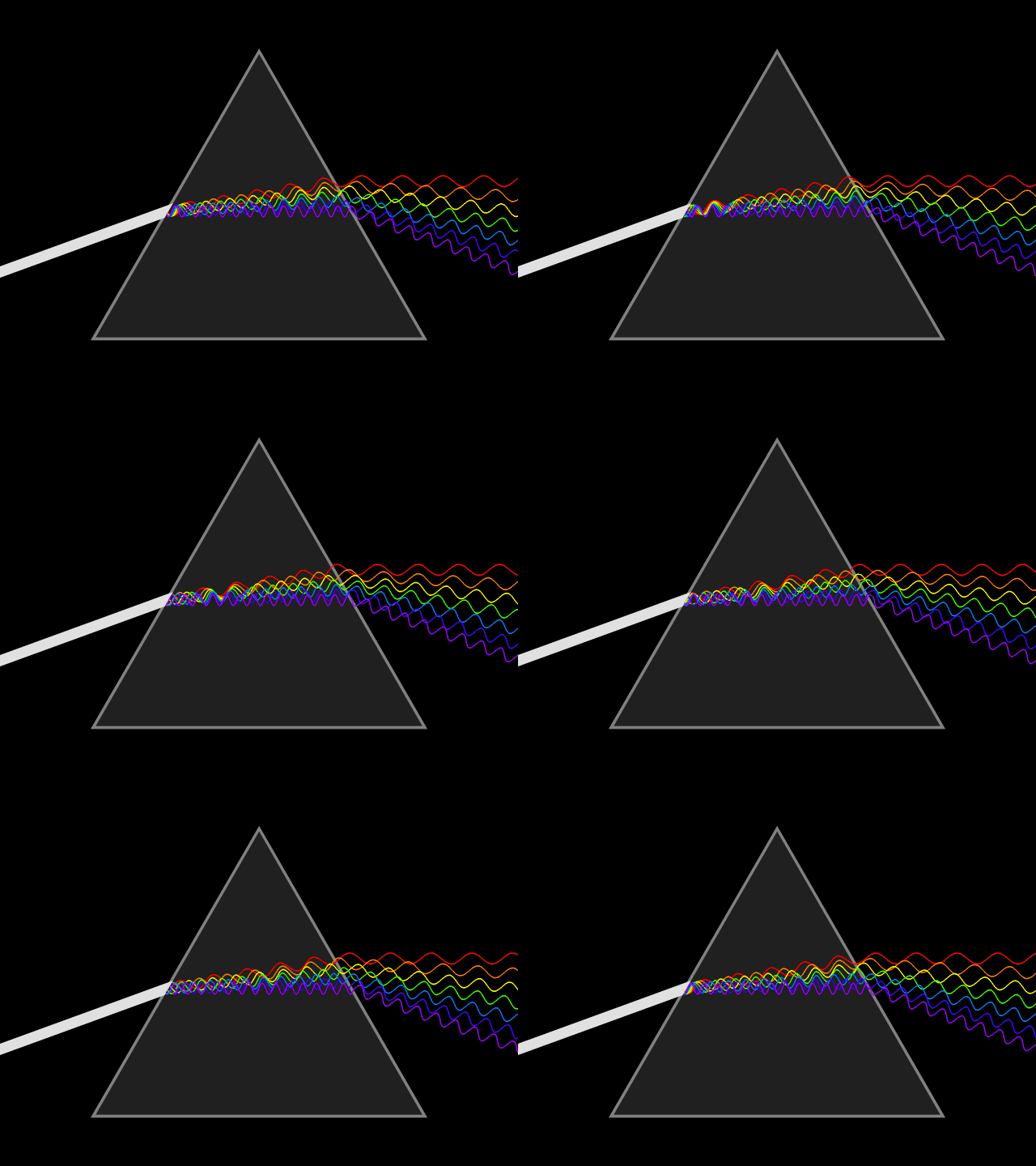 When
pioneering chemists and physicists began conducting systematic
experiments, they were measured largely by their ability to make and
explain their observations. However, as the centuries rolled on, we
became frustrated by the limitations of our senses. Newton's experiments
with optics for example paved the way for modern spectroscopy, where we
not only observe the colour (say) of a solution, but we can determine
the concentration of the coloured molecules, and we can also measure
chemical changes as a solution is heated, or following the addition of a
catalyst such as an enzyme. In fact analytical sciences has grown out
of our limited ability to observe events which lie beyond our aural,
visual, olfactory and tactile senses. Our desire to find out how things
work has driven the development of instruments like the telescope, the
microscope, the radio telescope, the spectrophotometer, the mass
spectrometer, the infra red spectrometer, the Nuclear Magnetic Resonance
spectrometer.....I could go on. However, we still rely on our own senses a great deal.
When
pioneering chemists and physicists began conducting systematic
experiments, they were measured largely by their ability to make and
explain their observations. However, as the centuries rolled on, we
became frustrated by the limitations of our senses. Newton's experiments
with optics for example paved the way for modern spectroscopy, where we
not only observe the colour (say) of a solution, but we can determine
the concentration of the coloured molecules, and we can also measure
chemical changes as a solution is heated, or following the addition of a
catalyst such as an enzyme. In fact analytical sciences has grown out
of our limited ability to observe events which lie beyond our aural,
visual, olfactory and tactile senses. Our desire to find out how things
work has driven the development of instruments like the telescope, the
microscope, the radio telescope, the spectrophotometer, the mass
spectrometer, the infra red spectrometer, the Nuclear Magnetic Resonance
spectrometer.....I could go on. However, we still rely on our own senses a great deal.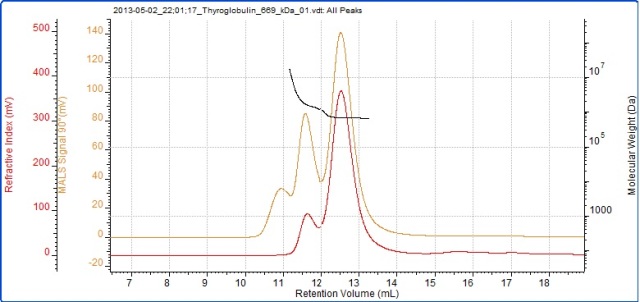
When as a professional scientist, we receive the spectrum from an NMR experiment (in a drug discovery lab), or the sequence of bases in a gene from a DNA sequencer (in a genomics lab), or the reading from a spectrophotometric analysis of a patient's blood sample (in a diagnostics lab), we must make a judgement based on our observations of these different kinds of data. So observational skills are not limited to first hand witnessing of an event, they also relate to our ability to see patterns in data or to quickly spot something unexpected: a "shoulder" (see above, RHS) on a chromatography peak, a transient rate that precedes a steady rate of chemical change, or a transient orange colour that appears momentarily in a biological observation, or in a chemical reaction. It might even be a minute change in a read-out from an experiment at the Large Hadron Collider that suggests the presence of a new particle. Which of course should be treated with scepticism until it is observed again, and again, and by several others! But it is such observational skills that led to the discovery of the Higgs Boson.
Those writers, artists, actors, footballers and scientists who appreciate and work hard at developing their observational skills are likely to be the most successful. When you begin your experiments in the Innovation Labs, make sure you look closely at everything you handle and make copious notes. Getting into this habit early will really help you succeed in the future. Good luck with your experiments!

I love reading such type of blogs that impart great knowledge to people. This one is really like that. sunlighten
ReplyDeleteDear Hely Fely, (I hope that is your name!) first I am glad you enjoyed it and secondly, most important, thanks for commenting: only a small number of UTC students do and so it is very difficult for me to know how easy the Blog posts are to follow. Keep commenting. Best wishes
ReplyDeleteDave