Friday, 2 January 2015

January, 2015 Molecule of the month: Cytochrome P450(s)

It's a new year and I thought I would bring out the molecule I had intended to write about in November, I thought I would focus on another topic that links to the theme of malaria (at the UTC) , but which is of wider importance in understanding the way animals, in particular, deal with chemical challenges. The cytochrome P450 family of proteins (often abbreviated to CYPs; an example is shown on the LHS), is an important target for insecticides (take a look at the links at Nicole Joussen's web site in Germany) in dealing with the spread of malaria via mosquitoes, but it is also an important class of enzymes in the process of drug validation (I like the way Emily Scott has organised her research into CYPs and drug discovery here [and then follow her research links]). The first thing to say is that it isn't a single enzyme. The CYPs are a group of enzymes which facilitate the "metabolism" of foreign compounds (xenobiotics). From an evolutionary perspective, they provide a selective advantage in mitigating the impact of potentially toxic molecules. From an enzymological point of view, they are of interest since they handle a wide range of substrates, making the relationship between the chemistry of catalysis and the specificity of substrate recognition an intriguing challenge. Let's look at the general structure function relationships in the CYP superfamily and then consider their importance both fundamentally and translationally with respect to toxicology: drugs and insecticides.


The CYPs are modular molecules (top figure, LHS) comprising two domains: the substrate binding domain and the redox domain: the structure of the first mammalian CYP was published in 2000. The reaction catalysed by these enzymes can be generalised in the schematic figure shown Left. The structures of the substrates can be substantially different (see below, RHS for a comparison of two substrates handled by a single P450). The CYPs represent a class of enzymes where there is a common redox centre that is used to diffuse the dangerous aspects of the toxic molecule. Enzymes exist with specificities that are unique, but there are also situations where evolution has led to the retention of a useful engine (the redox centre) which is then attached through historic (genetic) events including gene fusions and recombination, to generate a range of primary structures that recognise different small molecules. 

This structure-function concept is a theme found a number of times in Biology. For example all Immunoglobulins (antibodies: see my January 2013 Blog on these molecules) have a common stem (called the Fc region) which binds to cell receptors, associated with many different antigen combining elements, enabling us to eliminate many thousands of potentially harmful molecules. In the case of CYPs, a catalytic engine is harnessed to a range of small molecule scavenging units, which then prepare the offensive molecules for downstream elimination (in humans) in the liver. 

The interest in CYPs lies not only in their role in toxicological investigations of new drugs, but also in the application of insecticides in the battle against malaria. The role played by CYPs (as well as other enzymes including glutathione-S-transferases and haem metabolising enzymes) has formed a major part of the research programme at the Liverpool School of Tropical Medicine. You can read more about this here by following the links from Professor Hilary Ranson, Head of the Department of Vector Biology at the School. Understanding the relationship between mutation and the genetics of insecticide resistance, in particular in respect of the CYPs, is one of the major areas of research in the field of Tropical Medicine. So the molecule for January, 2015 represents a major challenge for fundamental Biochemistry, but also occupies a pivotal position in the delivery of new drugs to the market and in the management of malaria.

Tuesday, 23 December 2014

Happy Birthday Sir Isaac Newton, born on 25th December 1642!

Christmas day is often associated with the "Heavens" and the appearance of stars in the night sky. Indeed, why else would we decorate trees and houses with fairy lights, if not to celebrate the contribution made by (arguably) Britain's greatest scientist, Sir Isaac Newton who was born on the 25th December in 1642? Newton not only laid the intellectual foundations for the Space Race that dominated the 1960s, but he (along with Liebniz) developed calculus, optics and in his later years made sure that our coins were the right size, shape and value (really!). 


So, from apples (fruit used to be a common Christmas gift, and we have some red balls on our Christmas tree, don't you?), to starry skies all the way through to gold coins (these days commemorated by chocolate covered in gold foil); it isn't surprising that Sir Isaac is so fondly remembered every year at this time. I am of course joking, but he was reportedly born on Christmas day!


So why is Newton so important and why do many believe him to be the most significant scientist/mathematician (possibly) ever? Also, why in recent years has his reputation been "damaged" by revelations of his fascination with "alchemy"? (I can recommend Michael White's "The Last Sorcerer" as a last minute book for Christmas, if you want to read more on this). I believe Newton's greatest talent was to bring together the scientific concepts that dominated the "Natural Philosophers" of the day within a robust mathematical framework. As I complete my undergraduate third year course on Systems Biology, I am frustrated by our (the large community of Life Scientists, Physical Scientists and Mathematicians, including Computer Scientists) tardiness in producing a coherent mathematical framework for most of the observations made in molecular and cellular biology over the last hundred years. Granted, there have been some examples of significance, but it is difficult to imagine how we are going to extract the full potential from the recently announced 100 000 genome project! However, we shall, even if it takes longer than many of us would like! Newton might have dabbled in alchemy, but everyone loves an enthusiast, and let's face it not every book published, play performed, painting painted or piece of music written by the great artists over the years have been all of the same standard! So for me Newton is my favourite Scientist, and the one whose talents I most admire. We need more Newtons!

Does the Life Science field have an historical figure as powerfully influential as Newton? Of course we do! It's Charles Darwin. Born a couple of days before St. Valentine's day in 1809, Darwin's ideas are, like Newton's, made so profound by his ability to draw strands of information together to produce a coherent whole: hence the Theory of Evolution. (I recommend "Darwin" by Adrian Jesmond and James Moore for those interested, and Steve Jones' update on Darwin: "Almost Like a Whale"). The challenge for everyone at the UTC, is to bring your talents, enthusiasm and imagination to bear on the genome revolution that largely lies ahead of us: harnessing the knowledge of the 20th century to improve Global Health. We need more Darwins!

So, no pressure then!

Happy Christmas to all students and staff at the Liverpool Life Sciences UTC, and see you all in the New Year to see what we can achieve! 

Dave Hornby

Friday, 5 December 2014

Christmas molecules: What parasite makes you want to kiss?

Most cultures have some form of celebration around this time of the year and in Britain you'll find the market stalls selling holly and mistletoe. If you stay still, it wont be long before you can hear the sound of Christmas carols as you go shopping, where you might hear tales of frankincense and myrrh. You may also wonder why! Holly is a plant that can be found in various forms all over the world and its bright red berries and dark green leaves make it very popular for decoration in all cultures. But what about frankincense and myrrh? These are resins that have been extracted from trees and have been used by many cultures to provide a rich atmosphere during worship and celebration. They contain terpenoid molecules and, in the case of frankincense, the compound beta boswellic acid (shown RHS) is also thought to
have therapeutic value. However, the chemistry of these aromatic compounds and the essential oils found in the resin preparations is in my view outshone by the parasite that we have decided should give the signal for strangers to give each other a kiss! I am of course talking about viscum (amongst many varieties), better known as mistletoe! It is a plant but also a parasite (technically a hemiparasite: hemi, like semi means half). This plant that grows all over the world has, in contrast to holly, white berries, and again it has been claimed to have medicinal value. However, it 
became traditional to kiss under the mistletoe in England first, and then America. So we, as well as many other cultures have adopted medicinal plants as good luck symbols and during the holidays, I am sure you will all be celebrating in your own way with your own traditions. If you know of any other traditional plants that your family like to have at home let me and John know in the innovation labs. Why? Well in the New Year, Y10s and 11s will be trying to isolate therapeutic molecules from plants: trying to see which are the the most effective. Can anyone tell me which plant extract is used to treat malaria? 

Thursday, 4 December 2014

Progress in Science depends on "the Literature",which comprises peer reviewed reports that describe a set of experiments or theories and reach a conclusion in the context of all related preceding work. Papers (as they are generally called) are published in Learn-ed Journals (such as the Philosophical Transactions of the Royal Society, the Journal of Molecular Biology, Cell, Nature, Science etc); I shall confine myself here to Scientific Journals. Since all scientists must trust the work of others, there are some important criteria that you must apply when incorporating historical data or ideas into your own work. Some of these criteria are easy to determine, others depend on the integrity of the scientist who publishes and those who support its publication through the peer review process. The format of a Paper is essentially the same in all mainstream Journals and comprises the following sections: Title (Which should be self explanatory, and will be more or less technical depending on the "appeal/reach" of the Journal (more later).

The role of citric acid in the intermediate metabolism in animal tissues. 
List of authors and affiliation(s) (often the order signifies proportion of contribution, but in some fields may be alphabetical). An example would be:

KrebsH.A. and JohnsonW.A. (1937Enzymologia 4148—156.

The Department of Pharmacology, University of Sheffield 

or more recently, 

Mammalian 5′-Capped MicroRNA Precursors that Generate a Single MicroRNA

  • Mingyi Xie, 
  •  
  • Mingfeng Li, 
  •  
  • Anna Vilborg, 
  •  
  • Nara Lee, 
  •  
  • Mei-Di Shu, 
  •  
  • Valeria Yartseva, 
  •  
  • Nenad Ε estan,
  •  
  • Joan A. Steitz (2013) Cell 155 
  •  
    1568–1580


  • Department of Molecular Biophysics and Biochemistry, Howard Hughes Medical Institute, Boyer Center for Molecular Medicine, Yale University School of Medicine, 295 Congress Avenue, New Haven, CT 06536, USA, Department of Neurobiology, Kavli Institute of Neuroscience, Yale University School of Medicine, 333 Cedar Street, New Haven, CT 06510, USA, Department of Genetics, Yale University School of Medicine, 333 Cedar Street, New Haven, CT 06510, USA


    • Abstract (a short summary of the salient features of the work, this is often all that many people read! The content is used to index the work in libraries/search engines).

    Introduction (This provides the background and context to the work and often summarises the approach taken and the main focus of the work). Materials and Methods and Supplementary Information (This is the section that provides the reader with all information required to repeat the experiments. It will include the methods used to isolate cells, purify proteins, measure enzymes etc. It often describes the model of instrument used and the suppliers of materials). Results (This describes the data obtained at each stage of the work which generally includes Tables, diagrams, photographs and graphs etc.). Discussion (In this section the authors contextualise their results and interpret them, usually attempting to confirm their initial hypothesis or establishing new one(s)). Conclusion (This section summarises in a succinct and concise way the key findings and will often comment on its "fit" with the work of others, or not as the case may be!) Acknowledgements (Here the authors thank collaborators for supplying ideas, thoughts, materials and the funding bodies for studentships, fellowships and general financial support. If the work is sponsored by a commercial organisation, or alternatively if the authors receive support from a profit making concern, such interests are declared here). Bibliography or References (The Papers that underpin the work above are cited in full in order that interested readers may "follow up" on any aspect they find important. References cited are generally to Papers, but may also include books, web sites and patents

    This format is not universal, the order of sections may be different in some journals and sometimes the last three sections may be conflated.

    Impact factors "All papers are equal, but some are more equal than others", to steal a phrase from George Orwell. Impact is used to "quantify" the "reach" of a piece of research, either in academic terms (Journals report their impact factors annually), or in economic terms and sometimes in respect of changing opinion or improving the quality of a Nation's health (see the wiki link, section entitled controversy and criticism) . The top journals in respect of academic impact are often Nature, Cell and Science, reporting impact factors (IFs) of 42, 33 and 31 respectively. These numbers compare with more specialised journals such Journal of Biological Chemistry (4.6), Biochemistry (3.2), Journal of the American Chemical Society (11.4), Genetics (4.9), Journal of Bacteriology (3.3). The calculation of the IF is based on annual data for citation of the papers published in the Journal over the course of a complete year (not just how many times the paper is read, but how many times it is referred to in another paper). These numbers don't scale well, but suffice to say 4-8 is mainstream, 8-20 is outstanding and above this to 40, is stellar! The position of an author's name may reflect their contribution: a lab supervisor (or PI, or Principal Investigator) often places his/her name last, while the individual (or several of them) who have made the greatest intellectual contribution and have carried out the majority of the experiments, appear first (if there are equivalent contributions, the names appear alphabetically). In assessing the CV of a candidate for a Science position, the position in the list of authors can make a major difference (one way or other!).

    Nature recently published an overview of some the most highly cited papers in the last century. See here.

    Getting a paper published. In fundamental research (Universities and Research Institutes) it is your publication record (quality and number, or volume) that largely determines your reputation, your status in an organisation and the likelihood that you will receive the funds required from outside agencies (in the UK, Research Councils, Charities and Industry) to pursue your interests. Therefore the expression "Publish or Perish", first coined in academia in the USA, in the early 1930s, is behind the drive to publish: no papers, no funding, no career! The mechanisms for publication are simple enough. Each Journal provides a set of "Instructions to Authors", the lead author prepares the data in the appropriate format, writes the sections and then submits the "Manuscript" to peer review. The manuscript is distributed to several "experts" who provide an anonymous critique, often being asked to comment on the quality of the work, the significance in that field together with the impact it is likely to have. These comments are collated (scores are often given) and the Editor of the Journal makes a decision to either Accept, Reject or Revise. The author is given feedback and has the right to appeal, with differing levels of likelihood of a change of decision being related to the IF of the journal. The whole process takes a few weeks to several months depending on the Journal. There are criticisms of this system and some journals insist on transparency in reviewing, although it is a system that has lasted a long time. I suspect peer review may well be challenged in the near future owing to the sheer volume of papers being submitted and the use of multiple channels for the communication of results of research over the internet.

    How to read a Paper. The literature is diverse: this is particularly true if you read a section from a paper published in the 1960s, with a comparable paper from this year.


    ..........and for comparison:

    "Introduction

    Replication of eukaryotic genomes follows a strict temporal program with each chromosome containing segments of characteristic early and late replication. This program is mediated by the locations and activation timing of replication origins along each chromosome (Rhind and Gilbert, 2013). Expressed genes tend to reside in early-replicating region of the genome (Rhind and Gilbert, 2013). Compared to early phases of replication, late phases of replication are faster, less structured (Koren and McCarroll, 2014), and more mutation-prone; late-replicating loci have elevated mutation rates in the human germline (Stamatoyannopoulos et al., 2009), in somatic cells (Koren et al., 2012), and in cancer cells (Lawrence et al., 2013). Structural mutations and chromosome fragility are also more common in late-replicating genomic regions (Koren et al., 2012 and Letessier et al., 2011). At the other extreme, chromosome fragility (and consequent mutations) are also increased at specific “early replicating fragile sites” (ERFSs), a subset of early replication origins at which interference between replication and transcription leads to double strand breaks (Barlow et al., 2013Pedersen and De, 2013 and Drier et al., 2013). These aspects of genome replication are conserved all the way to prokaryotes, in which genes close to the replication origin have increased expression relative to genes close to the terminus (Slager et al., 2014 and Rocha, 2008), essential genes tend to be co-oriented with the direction of replication fork progression (Rocha, 2008), and the rate of mutation gradually increases with distance from the origin (Sharp et al., 1989), although close proximity to the origin can lead to structural alterations under conditions of replication stress (Slager et al., 2014).
    A genome’s elaborate program of DNA replication is therefore strongly connected to genome function and evolution and could, in principle, be an object of variation and selection itself. However, it is not known whether DNA replication timing varies among members of the same species, nor whether such variation is under genetic control. Previous studies have concluded that replication timing is globally similar among individuals of the same species (Ryba et al., 2010Ryba et al., 2012Hiratani et al., 2008Pope et al., 2011 and Mukhopadhyay et al., 2014). We hypothesized that this global similarity could still in principle coexist with interindividual variation at many individual loci and that such variation might be used to find genetic influences on replication timing."

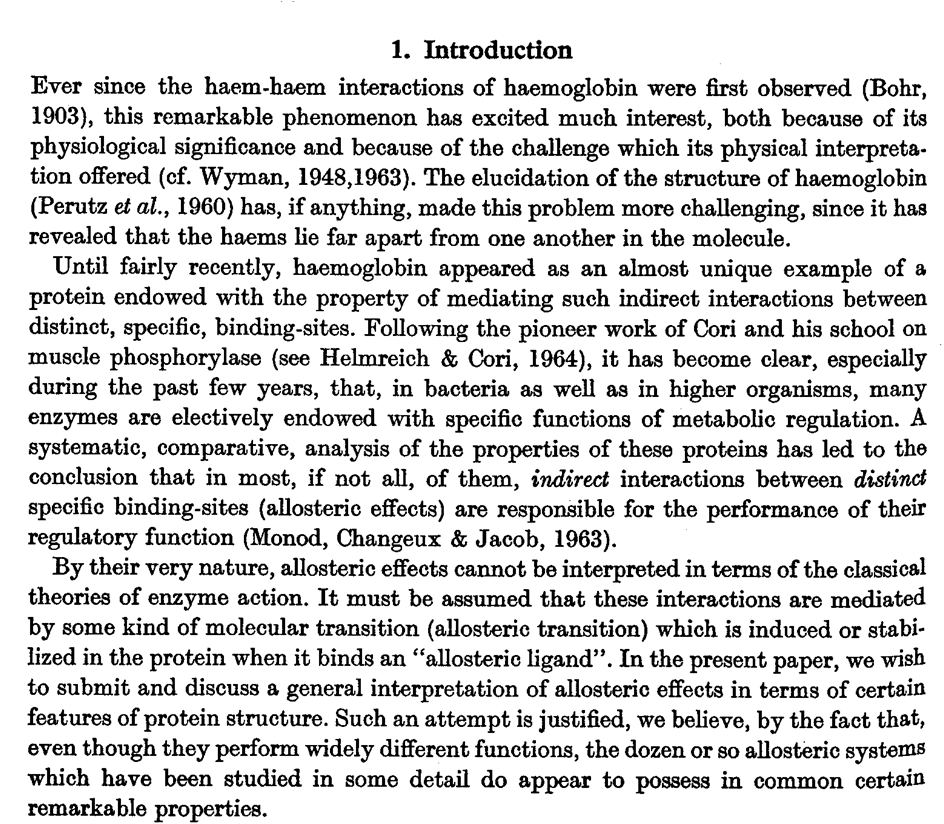
    The introduction sets the scene in both, but the economy of language is more apparent in the second example. However, the first paper is a "classic", in which Monod, Wyman and Changeux tried to rationalise cooperativity of enzymatic behaviour though a mathematical model. I think you'll agree both are well written with clarity and conciseness. The most important advice I can give when reading papers, is to be sceptical and question the data and the conclusions drawn: try and establish whether the paper achieves its objectives and persuades you of its conclusion. Look at the cited papers; and search the literature yourself, in case key papers (in your view) have been omitted. Reading a paper superficially may be appropriate if you are trying to establish its value for your own work: however, when you have established that it is useful, read it in detail, follow references, check methods and ideas that are unfamiliar to you in books and other papers. And don't forget, you can always email the authors, providing they are still active in the lab. The ability to make comments, check numbers of downloads etc is changing the face of scientific publication, but remember not everything you search for is on PubMed (especially old papers) and I like to combine specific searching with browsing the content of the General Journals like Cell, Nature and Science. 

    Saturday, 29 November 2014

    Prostaglandins: Molecule(s) of the month for December

    I was driving to Liverpool a few days ago listening to the first part of the annual BBC Radio, Reith Lectures. In fact I was probably at the same point on Edge Lane, when I was struck by Grayson Perry's disruptive, irreverent and insightful take on the art world last year. This year, Dr. Atul Gawande is tackling the topic of contemporary medicine and in his first lecture, he posed the question: Why do doctors fail? In his moving description of his son's encounter with the medical profession, he mentioned the use of a class of drugs based on the prostaglandins. In the case of his son, Walker; an early tragedy was averted by the doctor's administration of Prostaglandin E1. This prevented closure of the patent ductus arteriosus in the newly born, Walker, had symptoms of a cyanotic (Gk dark blue colour) heart defect (the skin has a blue/purple colouration, owing to a deficiency in the supply of oxygenated blood, for which there are a number of causes). It made me think that prostaglandins (PGs) are often overlooked in mainstream Biochemistry courses, and yet they are a potent class of molecules. This is an attempt to whet your appetite for the prostaglandins!


    Prostaglandins are derived enzymatically from essential fatty acids: they are 20 carbon molecules with a 5-membered ring, as shown on the RHS for Prostaglandin E1 (or Alprostadil). The enzyme Phospholipase A2, converts diacylglycerol to arachidonic acid, which in turn is converted to the prostaglandins by the enzyme called cyclooxygenase (or COX, for short). The main function of COX is to catalyse the formation of the "signature" ring, found in all prostaglandins, through ring closure and the addition of oxygen. You may have come across these enzymes, since they are the targets of one of the most
    commonly taken drugs, aspirin. The mechanism of action of aspirin, lies in its irreversible acetylation of a key Serine side chain in the COX enzyme. Other pain killers/anti inflammatories, such as ibuprofen act on the same target, but are reversible (ie non-covalent) inhibitors. This work was recognised by the award of a Nobel Prize in 1982 to (Sir) John Vane, along with two others. The structure of aspirin (purple) is shown in the active site of a COX enzyme on the LHS. The Serine at position is acetylated as the aspirin molecule is hydrolysed in the active site. As a result, arachidonic acid is now prevented from entering the active site of the enzyme and consequently no PGs can be synthesised. 

    There are around 10 receptors that specifically recognise and mediate the potent effects of PGs. These interactions are in turn "transduced" by G-protein coupled receptors (GPCRs, shown on the RHS) leading to reprogramming of normal hormonal responses, contraction and dilation of smooth muscle cells and a wide range of other physiological effects. We do not yet have a high resolution structure of the PG receptors, but I am sure it wont be long. The interest from my perspective, is in a compound class that is so potent. It reminds me of the story surrounding thalidomide, which you can read in an earlier Blog. The combination of the hydrophobicity, the structurally constraining ring and the oxygen atoms, give PGs their potency, when coupled to the GPCR pathways. But, as a simple biochemist, the challenges brought by working in the lab with such insoluble molecules, make me think I took the easy route early in my career by choosing amino acid dehydrogenases and DNA modifying enzymes, where everything can be carried out in the aqueous phase. Now, every time you take an aspirin, think of the molecular pharmacological events that you have triggered!

    Saturday, 8 November 2014

    Jack's project first steps: just a phase we are going through!

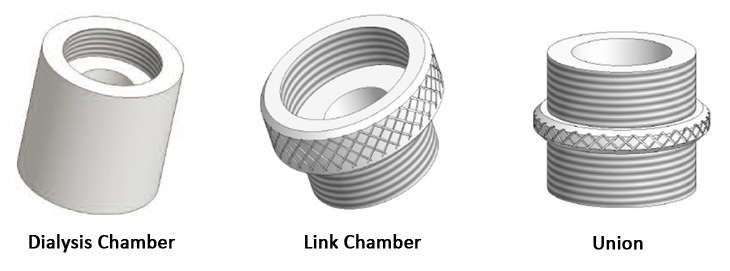
    I thought it might be helpful to other students (and Jack and me!) to share some thoughts on the Y13 lab projects. I shall work through them all, but since it is on my mind, I thought I would say a few words about Jack Condron's project. Jack asked if he could develop a device for cleaning contaminated drinking water. His idea was to create a cheap and simple solution for helping solve one of the major challenges in developing countries: access to clean drinking water. A laudable ambition, and one that has and continues to occupy the minds of many scientists, engineers in both research organisations and commercial organisations. One patent image is shown on the LHS. The key to this project is simplicity and a solution that is independent of any power supply: i.e. purification might result from a shake or a hand operated mini-pump.

    The first thing to point out is that Jack's initial thoughts, combined with his determination and drive was enough to get me behind him. We then started thinking about "proof of concept" experiments, the need for certain materials and reagents and in particular how we might "mimic" the system we are trying to develop. One of the great things about the UTC's Innovation Labs is the access we have to a 3D printer, and, more importantly, George Rule's ingenuity. So, Jack and George created a small "printed" chamber for testing the extraction of water from a "dirty" mixture. I have shown a competing design above, Jack's design is currently our in house design and will remain undisclosed for now. In simple terms, Jack's design comprises, two, 2ml compartments that can be connected, with a dialysis membrane providing an interface. This will allow us to establish whether our "chemistry" can achieve the desired result.

    We sat down and thought about the model experimental system and our through our discussions it became clear that "phase transitions" and an understanding of solubility of molecules in water and organic solvents was only superficially taught at A level. Moreover, the use of a simple and safe polymer for creating phases, such as polyethylene glycol (PEG, for short), was also something for which a strong theoretical base was off curriculum. At this point Jack was beginning to wonder what had happened to his desire to save lives! (Me too!). I then thought, we need to "see" the movement of contaminating species between phases and across membranes. We needed a dye that was water insoluble, but reasonably soluble in ethanol and polyethylene glycol. Orcein, came to the rescue (top LHS).

    We now have water, orcein, ethanol, PEG (at three mean molecular weight lengths), an experimental chamber and a water soluble dye (still under investigation). Jack also, threw in bleach tablets for good measure, thinking about the use of calcium hypochlorite (top RHS) for water purification, and as a compound that we might need to eliminate. So we now have to understand not only the physical chemistry of such mixtures, but also the reactivity of a strong oxidising agent as well. 

    Jack has been exploring how these molecules behave in solution when mixed in a range of combinations. We are on a journey rich in chemistry and one that seems to be taking us farther and farther away from the end point, but (I like to think) deeper and deeper into fundamental chemistry. The visual demonstration of PEG:water phases (used to drive counter current distribution separation technology), the mixing of ethanol in water and the differential partitioning of dyes has been the first "learning" phase (sorry!). Jack has already noted that polymer length (PEG is shown top LHS) can also influence the absorbance maximum of the dye (purple to red shifts are reproducibly obtained). Dye precipitation at water PEG interfaces can be followed with time and then of course there is the observed "bleaching" of absorbance caused by the bleaching tablets. Does "bleach" affect all 8 component of the dye? Can we explain the bleaching of polyaromatic dyes and does the same phenomenon occur with similar water soluble polyaromatic dyes?

    How does this help us with the initial aim? Well it helps us in many ways. First and foremost it is training a young enthusiastic scientist at the UTC, how challenging research can be, even when the problem seems (at face value) so simple. It is providing Jack with a terrific foundation in the relationship between pure and applied chemistry and empowering him as an investigative scientist. The fact that he is a Y13 student at the UTC, constantly amazes me! Jack is at an early stage in the project and I shall follow up at Christmas with project and he will write the third and final blog!

    To follow, Kelly's project: fingerprints, identical twins, epigenetics and Alan Turing's legacy.

    Thursday, 6 November 2014

    How the BLAST rendered me speechless today. Molecule of the month November 2014 FOXP2

    I started this Blog, intending to look at the properties of gunpowder, but remembered I had discussed dynamite in October, so two explosive molecules in the same number of months, seems a little excessive! Then I started writing about Cytochrome P450s, but although I was ready to go with the P450 story, I realised how nicely the FOXP2 protein structure, function and genetics fitted together in the BLAST sessions today. So, P450 for Christmas and FOXP2 for November. This is a story that might leave you speechless!

    The human genome project has proved a treasure trove for evolutionary biologists, and a quick search of a well known gene encoding say haemoglobin or a histone protein, will inevitably identify a closely related sequence in chimpanzees, orang utans or another ape. So far not surprising. However, I then asked the question: what genes would you expect to point to differences between man and apes? I was delighted when someone gave the answer "communication" genes. So of course I suggested an analysis of the "language" gene, FOXP2. 

    The FOXP2 protein is a transcription factor (here you can find a lovely summary with simple sketches of transcrition factors in higher organisms) found widely in the genomes of mammals, that is a regulator of neuronal plasticity, with a direct impact on speech and language development. The protein sequence that you all obtained, showed a dominant feature: a run of tens of Q (Glutamine) residues. These are located at the N terminal side of the protein sequence and are not uncommon in some DNA binding proteins. In addition FOXP2 contains a zinc finger and a leucine zipper, both of which are protein sequence motifs, often associated with DNA binding. From a bioinformatics perspective, the FOXP2 sequence is a dead give away! Transcription factors bind to DNA and RNA Polymerases and promote gene transcription (expression). In the case of FOXP2 it regulates the levels of expression of a set of genes involved in language development which are mapped to the brain. The FOXP2 gene, therefore encodes a "master regulator" and mutations to the sequence  of such genes can be disastrous, leading to negative effects on a significant range of "downstream " functions.

    Full-size image (74 K)
    The protein (shown left in complex with DNA from the work of an international collaboration published in the journal Structure) recognises a specific DNA sequence. There are two amino acid substitutions between the FOXP2 proteins between chimpanzees and man, which appear to interfere with the function of FOXP2 in such a way that the coordinated expression of a family of genes required for speech is not possible in apes. The story was made possible by pioneering work from communication scientists at McGill and London Universities, and geneticists at Oxford University and the UCL in London. From a family with a rare, inherited speech disorder, the region of the chromosome containing the mutation came the first clues. Shortly afterwards, the FOXP2 gene was isolated and, as with apes, the changes in function relate to subtle amino acid differences: you should attempt to rationalise these observations. You will find that FoxP2 from a number of species is highly conserved, but look closely at the features in the protein primary structure. Subtle differences can give rise to profound functional consequences, which makes a powerful case for understanding the details of chemistry, structure and reactivity of amino acid side chains in understanding biological phenomena: in this case language skills!

    The FOXP2 gene expresses a protein that regulates the levels of expression of a subset of genes which in turn cascade down information that leads to coordination of brain function leading to controlled action of facial muscles and the larynx, thereby producing speech. It should also be remembered from your BLAST searching that by way of contrast some protein sequences can tolerate significant amino acid changes without loss of function. The critical evaluation of protein sequences is the key to a deep understanding of function, so always treat similarities with a healthy level of scepticism and try to validate ideas by experiment, where possible.