Thursday, 3 July 2014

Molecule of the Month July: ATP synthase

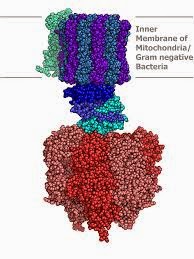
I changed my mind at the last minute over the molecule to send you on your way over the summer. I had intended to wax lyrical over the carbohydrates that decorate the surfaces of many bacteria, but I'll save that for a later Blog. Instead I though we all needed an injection of post examination energy, and what better than the ATP synthesising machinery exemplified on the left by a bacterial example. This enzyme is responsible for converting ADP (adenosine diphosphate) into the energy currency of the cell, ATP (or adenosine triphosphate). As an undergraduate, I was taught the alternative models that were current to explain the production of ATP in the cell, but the final explanation was somewhat unexpected and a triumph for one man in particular (Peter Mitchell), who stubbornly refused to be deflected from his unpopular ideas on the mechanism of ATP production.


Peter Mitchell graduated from Cambridge over 60 years ago: in fact his first project proved unsatisfactory, but in 1950 he finally earned his PhD stripes. ATP was first discovered in 1929, and in the period 1940 to 1960 the compound was synthesised chemically by Todd; a few years earlier, Lipmann had recognised its potential for harnessing biochemical energy, but despite a considerable effort attempts to rationalise the data, the evidence for its biological synthesis remained unsatisfactory. From the insights of a great British Biochemist RJP Williams, however, Mitchell was able to propose how harnessing the energy in a proton gradient, established acoss biological membranes, could be coupled to the synthesis of ATP. That is, a proton-motive-force drives structural changes in the ATP synthase: this was corroborated by the work of the famous enzymologist Paul Boyer from Los Angeles and our own Sir John Walker (below left, at Cambridge).


The union of ADP and inorganic phosphate is brought about (against an adverse energy barrier) through the coupling of a conformational change in a subunit of the ATP synthase and the movement of protons across a membrane. At the time, this idea was radical, so much so that Mitchell was forced to build his own private research facility on Bodmin Moore (a favourite location for Gothic mysteries, and the legendary home of King Arthur and the sword excalibur). The reclusive Mitchell (along with his brother) resorted to publishing his own ideas. First, it was published as a pamphlet, but two years later, he followed up with several small volumes called “little grey books” named after their rather unexciting covers.  Just like change, investigative research is constant, and in the early 1970s, his theory gained significant acceptance among his peers and the scientific community in general. Meanwhile, John Walker was developing the exacting purification methods in order to obtain the mg quantities necessary for detailed structural studies:. With a structure in hand predictions can be tested, although the scale of this task was a major challenge and the confirmation came slowly. 

The work of John Walker's lab at the Laboratory of Molecular Biology, together with the mechanistic insights from Paul Boyer and the pioneering work of others, represented a collaborative tour de force which led to the award of a Nobel prize in 1978.  The ATP synthase molecule is much larger than most enzymes (it is clearly visible in electron micrographs of the inner mitochondrial membrane). The model right, illustrates the build up of a proton gradient, either side of a membrane: this reaches a critical threshold, at which point the base rotates as shown. This is coupled to the phosphorylation of ADP: the flow of electrons along the electron transfer chain, arranged on the inner mitochondrial membrane promotes the formation of a proton gradient that provides the energy for ATP production.


A brief word on ATP is required here. Fritz Lipmann had identified the importance of this molecule in providing cellular energy, but why is it so special? The hydrolysis of the terminal (gamma) phosphate converting ATP to ADP and inorganic phosphate (the reverse of the ATP synthase reaction), yields approximately 30kJ/mol (the hydrolysis of 2 phosphates, yields around 45kJ/mol and AMP) of energy. The exergonic nature of this hydrolysis is in part due to the favourable resonance stabilisation of the free phosphate compared with ATP, together with the relative instability of a string of negative charges in ATP. Interestingly GTP (recall nucleic acids are built from ATP, GTP,TTP (or UTP) and CTP), is the molecule that provides the energy for protein synthesis: it has the same energetic characteristics as ATP and both are synthesised de novo and by recovery from fragments (a process called the salvage pathway).

The importance of ATP synthase and ATP cannot be overstated in Biology, and the development of the chemiosmotic theory that rationalises the chemistry and physics behind this process is as fascinating as the scientists involved.

Wednesday, 2 July 2014

I know you all, and will awhile uphold the unyoked humour of your idleness...

Today I not only attended my first school assembly since around 1977, but I was invited by the Vice Principal, Mr. Parry to say a few words of encouragement to the Y12 UTC students. I am used to presentations to Science funders, from charities and research councils to hard-nosed business people. I have learnt to dodge the bullets from academic colleagues when trying to get them behind a challenging Departmental decision, but I wasn't sure at all how to approach the end of term motivational talk to address some of the concerns students have about balancing their investment of time in their curriculum work over their general and science related enrichment sessions, as we approach the summer holidays. Should I go for the Brannagh version of Sir Tim Collins Iraq War speech? Should I attempt (always badly in my case) the Sir David Attenborough approach, or take on the mantle of Jon Butterworth for 20 minutes, delivering his Smashing Physics presentation? In fact only yesterday, I sat through some of the Society of Experimental Biology session in Manchester, on Public Engagement listening to seasoned campaigners like Alice Roberts of TV and Birmingham University fame, and Alf Game, an old hand at guiding academics through the minefield of the "impact agenda". But then I though, no, just talk about why I am utterly convinced by the UTC's approach to training a new generation of scientists, from my own experience.

Starting with my primary school teacher, Mr. Kennedy (10 months in, I am getting used to calling teachers Mr. again! But holding out on the suit and tie, you'll be pleased to know). He introduced us to the insides of pigs, the cross section of a sheep's eye, Mozart and the world of maths including that wonderful ratio called pi. He opened doors that I never knew were there. He was followed by teachers who educated me as best they could in Science, but it was the music teachers and the English teachers (Brian Young and Matthew Brown) who sparked my interest in Shakespeare, literature and languages (hence the Henry IVth Pt I reference). I think it was their collective approach of opening my eyes to the wider body of knowledge that worked for me, rather than formal curriculum material.

And then came the Science. After a short hiatus, I met my undergraduate tutor at Sheffield, where I had signed up for Biochemistry. But first, I must mention the boot camp Chemistry course offered by the University of Sheffield in 1977), which preceded the Biochemistry course, which I now look back on fondly, not least because of the inspirational teaching of Michael Blackburn (shown left). I can remember Mike (who I would come to appoint to teach enzyme mechanism to second year undergraduates about 30 years later when I became head of the department!) interrupting his lecture on some fundamental aspect of organic chemistry, to show us all a thermal print from a mass spectrometer of the small peptide enkephalin. At the time neuropeptides where state of the art and the endorphin story had earlier been the subject of a BBC2 Horizon documentary. Again I was hooked on science, but not through the formal course material, but more on what lay beyond (what my daughter always refers to generically as "Narnia").

Returning to Bill Ferdinand, I recall my first tutorial...but not until one term had elapsed. I was feeling badly treated by the Department, although the tutor who held the fort was very good, he wasn't my proper tutor. We realised when we met Bill for the first time, that he had returned early after having a lung removed: he was a smoker! I think the first session with Bill was a consideration of transition state theory in the catalysis of some well studied enzymes. After a few minutes, it became clear that in Bill's eyes, without a sound appreciation of Galileo and Plato, we couldn't get down to transition state theory and the Hammond postulate! Of course he was right and again he had unlocked another set of doors! But this time, I was ready to repay him. I buried myself in the history and philosophy of science, I read every classic paper on enzymes and I hung on his every word. Tutorials and lab classes (less so lecturers apart from Drs. Fowler, Watts, Ainsworth and Sykes) were the reason to get up in the morning. Bill, a brilliant young protein chemist who came from Liverpool and ended up in Sheffield via Oxford and the Rockefeller Institute in New York, sadly died before I graduated (his last few tutorials were given to his students at his bedside!). But, Mr Kennedy and Bill Ferdinand provided me with a passion for knowledge, Science and Biochemistry. But as I said this morning if I was smarter I would be applying maths to address the Natural Sciences. Oh well, there's still plenty of time left!

Back to the title, the young prince has at this moment in the play realised that the time for fun is over and the mantle of responsibility lies ahead. There comes a point (as I found with Bill) when you have to put something back and that's what I want you all to focus on! I have left out so many people who have made and continue to help me and inspire me. Rest assured they will appear here before too long!

Sunday, 29 June 2014

How good are we at predictions in science?

During Jon Butterworth's presentation at the UTC on Friday, I kept on thinking back to a comment from the late Richard Feynman during one of his Caltech quantum physics lectures (which can be bought as audio files). It was his expression of hope that might soon be realised in the early '60s, that the huge intellectual and financial investment in understanding quantum physics, would yield some tangible value for mankind. So when Jon Butterworth responded to students' questions (and indeed as he pointed out periodically throughout his excellent talk) about the value in searching for the Higgs particle, I thought the idea of improving our knowledge is one noble aim, but how do we translate the enormous investment in time and money into practical returns? Clearly, as he said in his Q & A session, the knowledge gained from the LHC experiments are unlikely to materialise for some years, but what of the Science we have collectively supported as a species in the last 50 years?

The so called "impact" of research in all areas of endeavour has recently been added to the assessment "tick box" list for the UK Universities, in the form of the 2013 Research Assessment Framework. However, I am taking a different approach here and asking much simpler questions. For example, can we use our knowledge of physics and chemistry to predict the colour of a solution of a dye molecule? Can we predict with certainty, that the introduction of a sequence of synthetic nucleotides, derived from genomics research, lead to the successful and economically viable production of therapeutic molecules like insulin on an industrial scale? Can we predict the three dimensional structure of a simple protein molecule such as the enzyme ribonuclease, based on a knowledge of its sequence (or primary structure) in conjunction with the structural data bases of thousands of three dimensional structures of macromolecules,  the study of protein folding chemistry and physics and access to high level computing time (a la CERN?).In other words can we repeat the successes of teh Industrial Revolution in the way that say, steam power was harnessed? If we cannot, why and what, if anything, has gone wrong? Or are we (since we are all part of the wider Scientific community at the UTC) guilty of raising unreasonable expectations in respect of new treatments for diseases and new sources of renewable energy?


Copper sulphate and the dye Brilliant Blue, are difficult to tell apart when in a couple of unlabelled glass bottles sat side by side on a lab shelf. Clearly we can carry out a number of analytical tests to improve on the limited analytical qualities of our own eyes. We could for example, evaporate both solutions: large flat diamond-shape crystals will appear in one bottle, pointing at that is copper sulphate (so far a good result for science!). If, however, a textile company starting up next door asked if we could suggest, or even synthesise a molecule that had the same colour blue (let's forget its suitability for remaining "fast" on the dyed fabric through harsh washing conditions etc.) to enable them launch a new product. Could we advise them on the likelihood that they could perhaps even protect its chemical composition, possibly through a patent application? 

My first thought would be to look at a number of well known dyes, add one or two chemical substituents (theoretically at first, or as they say these days in silico) and calculate the impact they would have on the distribution of electrons between all of the atoms in the molecular structure. From this I would reach for the quantum mechanical equations that allow me to define the energy levels of all of the components, the bond lengths and angles etc. and then predict the outcome when a solution of the modified dye is dissolved in water. Not too much of a challenge then! In fact the theory behind this dates back nearly one hundred years, but the challenge of applying it to high molecular weight dyes requires significant computational power. I am not qualified to comment on the accuracy of the appropriate formalisms that are used to interrogate the theoretical structures, but I understand that the bigger the molecule the further it deviates from the observed (using methods like X-ray crystallography). In addition therefore, it is likely that absorption spectra in the ultra violet and visible region are unlikely to be predicted with a level of accuracy that guarantees we can "know" the colour of such in silico molecular constructs.


So I conclude that quantum theory gives us a good means of approximating the molecular design of a dye with a given colour. Thanks to the theoretical insights of Planck, Bohr, Heisenberg, Lehnnard-Jones, Hartree and Fock (as well as many others I am too ignorant to name) we have a framework on which to hang our experimental ideas, but I would say less of a predictive basis on which to synthesise some seemingly elementary molecules. As Hesisenberg reassures us, uncertainty remains! Still more work to be done there then? So how good is our model for gene expression and the subsequent translation of mRNA into a therapeutic protein in Escherichia coli? These issues are the result of much less theory and apparently simpler experiments. Nevertheless, the contributions of Jacob and Monod to developing the concept of the operon in genetics, together with the cracking of the genetic code by Brenner, Nirenberg and Khorana (and others again!), together with all that followed until the first genes were cloned in the 1970s, represents a formidable achievement of modern Science.

I vividly remember my first attempts to clone a gene and induce its expression in E.coli. It was in 1985 during a thoroughly enjoyable post-doc in Tom Bickle's lab at the Biozentrum in Basel. This was before mainstream PCR, so restriction enzymes, DNA ligases and a small pallet of expression vectors were available from friendly academic labs. The amazing work from the bacteriophage community had led to the  application of a small sequence of DNA duplex (a promoter) for driving expression of a gene placed upstream (ahead) of it, when the temperature of the culture was shifted from 30 to 42 degrees. I wont go into the details of how this works, but suffice to say, the experiment worked, the gene was expressed and the protein duly purified and characterised. So, the conclusion would be that our knowledge of the DNA sequences that provide for regulated expression of a protein in E.coli are sufficiently robust as to allow anyone to design a piece of DNA (part of our Synthetic Biology Toolbox?) that will lead to expression of a protein in E.coli. 


However, when I tried the same experiment on a second gene, weeks of repeated cultures proved fruitless. Plasmids were reconstructed, different experimental strategies were developed. No luck. The test of success: a large blue blob in the middle of an otherwise transparent slab of polyacrylamide, failed to materialise. I cant remember what happened in the case of the next gene and the one after, but success, or my hit rate, was possibly 25% in my favour. So, another partial success for Science, but not the comprehensive victory we demand from the theoretical base of Molecular Biology. Certainly not an ideal platform for launching  a programme of Insulin production, or a new venture in Synthetic Biology, you might suggest! Well, maybe its not that surprising and maybe as developing and practising Scientists, we should be more "honest". But more importantly we should consider our successes and failures as outcomes that require further analysis and outcomes that need to be communicated more precisely.

I am not going to give you more examples of the above, but I did mention earlier whether we have been able to harness our knowledge of structural biology and protein chemistry and physics to predict the structure of a protein from the gene sequence that encodes it. The answer is that we have had some successes, but many more failures. However along the way we are learning about the gaps in our knowledge and the goal is important if we are to design new drugs more efficiently to treat the looming health problems as the population expands and ages. I believe these endeavours are an essential part of the human condition, and that we have an intrinsic drive as a species to address the unknown. I also believe that communicating Science (and indeed all knowledge, literature, music and art) should be placed at the forefront of education. We must be able to challenge the science that we generate. I do not mean that we all need to be able to check through and validate the equations that form part of the experimental design of the Higgs experiments, but more are needed: maybe we should aim to  increase the number by 10 fold!

The time and effort taken by scientists like Jon Butterworth to meet with young students and in other fora, more senior citizens is so vital. Thanks to the fantastic work of the Liverpool Science Festival team and those of the senior staff at the UTC in Liverpool in bringing scientists of his calibre together with a whole array of outstanding Scientists representing a range of disciplines at all ages has been one of this year's remarkable achievements at the UTC.
  

Saturday, 28 June 2014

Student-led project ideas have totally changed my views on research training

I remember my first encounter with Dr Barry Burnett, a behavioural geneticist who served as head of the department of Genetics following the retirement if Professor Alan Roper and just before the appointment of Professor Geoff Turner at Sheffield. Barry's office was wall-to-wall with books, text books, novels, journals and laboratory files and note-books, all interleaved with scientific bric-a-brac. A bust of Darwin looked longingly at lovingly engineered brass microscope and a glass case of peppered moths, carefully pinned with the care of a Victorian clergyman. Barry was (and still is) "old school". The picture left is of Sir Frederick Gowland Hopkins, one of Britain's most distinguished Biochemists in his Cambridge "office" probably between the war years: it always reminds me of Barry's office!

Barry and I discussed PhD student supervision and he told me that as a young academic, student applicants were expected to propose their own research projects. At the time (25 years ago), this would not have been the norm, but it certainly isn't today. In fact Professor Janet Hemingway (right)was a student in the same Genetics Department as Barry and she verified this story in her recent Life Scientific broadcast on Radio 4, as an undergraduate at Sheffield. However, the thought stayed with me that one day this might be interesting. The day arrived on Thursday. I invited both the Y12 and Y10 students to come up with ideas for their own projects for the next academic year. Here's what happened.


The first thing I knew, I was inundated with a crowd of students with ideas ranging from: biomimetics of bird and insect flight incorporating 3D printed models,  devising experiments to explore viral encephalitis, the basis of endometriosis, comparative analysis of enzymes catalysing the same reaction in different tissues, the design and fabrication of a bench top mass spectrometer (see earlier blog), the value of anatomy in contemporary biology (see the ruminant project in my last blog). And they kept coming: new sources of antibiotics to meet the Longitude Prize challenge, developmental analysis of the mealworm (our own model organism), the economics of different Healthcare sectors, the complex mathematics underlying patterns of behaviour in living systems, from regulatory enzyme kinetics, to diffusion control in early development, psychology-based survey of group work in labs compared with individual effort, the communication of complex science phenomena......

You get the picture!

The week before, I was thinking of proposing a set , something that builds on the year's mini-projects, but not now. My challenge is to harness their boundless enthusiasm and turn their ideas into practical challenges, which will run over their next academic year. I will be posting all of the projects, along with the student plans over the coming week. The value in supporting the students in pursuing their own ideas is incalculable and I am determined that we will go on this journey together without the "safety net" of a controlled set of "me-too" projects and I look forward to periodically reporting on our progress. It is clear that they are ready to experience the ups and downs, the highs and lows of a real research project, driven by their own passions.

In parallel with the projects, we are launching our UTC Skills Passport, which will be the subject of my next blog, and I'll fit in a molecule of the month for July too!

Sunday, 22 June 2014

Towards a Life Sciences Fab Lab at the UTC

The Fab Foundation, formed in the USA, early in 2009 aims to promote the growth of an international network of labs to educate, innovate and invent, using technology and digital fabrication thereby allowing anyone to make (almost) anything. The overarching aim being to improve lives and livelihoods around the world indirectly. At the Life Sciences UTC in Liverpool, we have embraced this concept through the integration of 3D printing and Molecular Life Science Research into our Innovation Lab programme. You will have seen in earlier Blog posts describing the ways in which students at Y12 are developing equipment to drive our experimental programmes, we are now aiming to adopt the Fab-Lab approach as a major component of our Y13 project programme. (Each project will be described in details in a subsequent post, but here are a few tasters in advance).

Understanding the evolution of ruminant physiology through gross anatomy and Bioinformatics, is a project that will combine anatomical observation with dissection of abattoir specimens of stomachs of sheep and cattle. The ruminant story allows us to explore the symbiotic relationship between ruminant microbiomes and ruminant Biology against the backdrop of genomics on these an related organisms. And we will "print" the ruminant stomachs (from polymers!) using 3D images, in order to support the study of this unusual mammalian organ.  The object of the research is to address the relationship between the microbial population and ruminant proteomes in the evolution of a fermentation system that converts vegetation into a "workable" source of nutrition.

The value of mass spectrometry in Molecular Biology research in the post-genomic era cannot be over-stated. However, the instrumentation and the physical principals that underlie its value are often consigned to a "black box". In view of the importance of this technology in Life Sciences, with its foundations in Physics, we are working with the Studio School electronics staff to build our own mass spec. Clearly, we will not be competing with our partners Thermo Fisher! But we will be using this as an exercise in stretching student skills and their understanding of a range of challenging concepts in physics. We will combine fabrication of parts with some off-the -peg components to work towards the assembly of a simple device. This has to be one of the most ambitious projects for next year, but I am excited to see how it goes!

These are just a couple of examples of how we intend to bring an interdisciplinary approach to the student experience at the UTC. However, as will be made clear in a subsequent Blog, these are student ideas, not mine or those of the teachers, that emerged during our project planning session and I believe that through the Fab Lab concept we will be pushing the boundaries of student achievement in schools. We are hosting visitors this week from the International Festival of Business 2014 in Liverpool. Last week we demonstrated the combination of Synthetic Biology and 3D printing. This week we will demonstrate the way in which this new technology can open up new avenues for research in a cost effective way that provides students with exposure to not only science, but computation, design, manufacturing and innovation.

Monday, 16 June 2014

Elementary, my dear Watson?

The difference between seeing and observing is a fundamentally important concept in Science. In my view, it was best described by Sir Arthur Conan Doyle, through his characterisation of Sherlock Holmes in his first published short story: "A Scandal in Bohemia", who was trying to explain the difference to Watson:


“You see, but you do not observe. The distinction is clear. For example, you have frequently seen the steps which lead up from the hall to this room.”
“Frequently.”
“How often?”
“Well, some hundreds of times.”
“Then how many are there?”
“How many? I don't know.”
“Quite so! You have not observed. And yet you have seen. That is just my point. Now, I know that there are seventeen steps, because I have both seen and observed.”
As we finish the project work in the Innovation Labs this year, we are going to examine the skills that you have been acquiring before you leave for summer. We shall incorporate a series of "tests" into Tuesday (Y10) and Thursday (Y12) sessions. Some of these tests will assess your dexterity and attention to detail, using the equipment including pipettemen (Gilsons), centrifuges, spectrophotometers etc., but some will ask you to write down your observations. 
You know how often I ask you to write down everything you see, from the colour of a sample, the smell, the number of legs on the mealworm larvae etc. There is a reason. A good experimental scientists doesn't just follow protocols with care and attention to detail, s/he also observes. I like this quote from George Bernard Shaw, Irish playwright, intellectual and co-founder of the London School of Economics.
"The power of accurate observation is commonly called cynicism by those who have not got it."
Why do I like this? Observations are key to turning just another piece of information into understanding. Think of Rosalind Franklin's processing of X ray data and Crick and Watson's observational powers with similar data sets in hand. Observations can often require courage, especially if they deviate from the consensus view. Perhaps this is why GBS used the term cynicism (ie an inclination to believe that people are motivated purely by self-interest; scepticism). When you see something that others don't some people don't like it. Well I do! So focus on observing and not just looking!

Sunday, 15 June 2014

Hornby, Liverpool's famous inventor, manufacturer and entrepreneur!

I am of course referring to Frank Hornby of Meccano fame! I read his Biography: Toy Story by Anthony McReavy over the weekend and it provided a nice example of the value in bringing together Science, engineering, maths and the key ingredients of successful business: manufacturing, economics and sales and marketing. However, business success associated with innovation and manufacturing one hundred years later must necessarily include considerations of sustainability and the environment as well as more developed elements of wage equality and welfare of the workforce. Of course all of these may impact on profit margins in the short term, but we now realise they are a key part of sustainability.

Frank Hornby (RHS) came from an ordinary family near Lime Street, and was born at the start of the railway revolution in Victorian Britain. What I find interesting is that Frank Hornby recognised the value of construction as a means of amusing and educating young children. Despite formidable difficulties: he had access to very little money, he had to develop his toys from a garden shed and the difficulties of outsourcing the manufacturing of components, Frank Hornby became one of Britain's most successful inventors and businessman combined.

His first Meccano sets were assembled and packaged in an amateurish way, and were expensive at the turn of the 20th century (40p!). However, he secured endorsement from Professor Hele-Shaw, an academic engineer at the University of Liverpool, which marks an interesting moment in the collaboration between industry, education and University research. It should also be mentioned that a few years earlier, the use of scale models was pioneered at the University of Cambridge, by the chemist William Farish (LHS). Farish was a great innovator in teaching: his concept of assembly kits that could be used to construct scale models of industrial machinery to aid in the teaching of the subject, became an important part of education in both engineering and architecture. He was, incidentally, the first person to introduce examination papers into University courses at Cambridge!

I have become fascinated by the way in which 3D printing, you could argue a logical extension of Meccano, is influencing our research programme in the Innovation Labs at Liverpool. The concept of design and technical drawing, building on Farish's introduction of "isometric projection" which later became a cornerstone of architecture courses in the UK and USA, is closely linked to some of the laboratory equipment design and 3D printing work that the Greenland Biodesign team (see earlier Blogs) are engaged in at the moment. The value of model building (without which Linus Pauling may not have thought of the alpha helix in proteins, and the DNA double helix in the case of Watson and Crick!) cannot be overestimated in Science.

I am looking forward this week to hosting a group of Business delegates in the UTC innovation Labs, as part of the International Festival for Business in Liverpool. I am aiming to demonstrate the teaching approaches that we are developing to train a new generation of Young Scientists by a hands on session in which we will incorporate aspects of Synthetic Biology and 3D Printing. As the Nobel Prize winner Sir Harry Kroto (and others) have pointed out  "Britain needs more Meccano and less Lego", by infusing our Science programme with contemporary research methodology, design and manufacturing concepts, together with an appreciation of business principles, I believe we can not only produce a Frank Hornby for the 21st Century but a group of young scientists who will make a real difference to our collective futures.